
Why 90% of OPT Candidates Never Hear Back From Recruiters (And How to Get More Interviews in 2026)
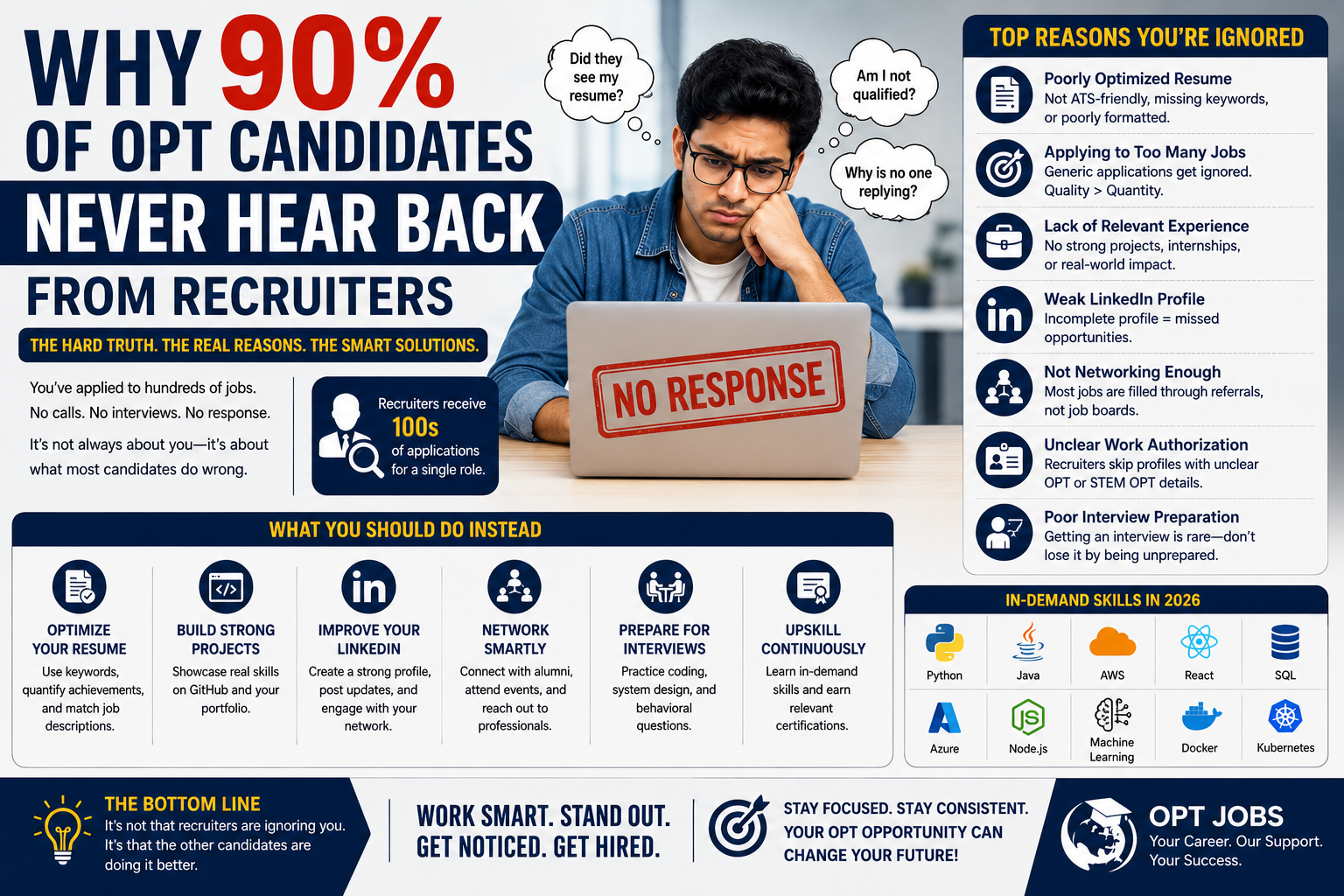
Why 90% of OPT Candidates Never Hear Back From Recruiters (And How to Get More Interviews in 2026)
Why 90% of OPT Candidates Never Hear Back From Recruiters
Every year, thousands of international students complete their degrees in the United States and begin searching for jobs through Optional Practical Training (OPT). They polish their resumes, create LinkedIn profiles, and apply to hundreds of openings, hoping to secure their first full-time opportunity.
Yet, many experience the same frustrating outcome—silence.
No interview invitations.
No recruiter calls.
No feedback.
If you've been applying for weeks or months without success, you're not alone. According to industry trends, recruiters receive hundreds of applications for a single position, making the hiring process more competitive than ever.
The good news is that most candidates aren't rejected for lack of talent. They're often overlooked due to avoidable mistakes in their job-search strategy.
Let's explore why many OPT candidates never hear back—and what you can do differently to stand out.
The Biggest Mistake: Applying to Every Job
Many graduates believe that submitting more applications increases their chances of getting hired.
The reality is quite different.
Sending 300 generic resumes to 300 employers usually produces fewer interviews than sending 30 well-targeted applications.
Recruiters can immediately recognize resumes that haven't been customized.
Instead of applying everywhere, focus on positions that closely match your:
- Technical skills
- Academic background
- Internship experience
- Career goals
Quality always beats quantity.
Your Resume Isn't Passing the ATS
Most large employers use an Applicant Tracking System (ATS) before a recruiter ever reviews your resume.
The ATS scans resumes for:
- Skills
- Keywords
- Job titles
- Certifications
- Education
- Relevant experience
If your resume doesn't match the job description, it may never reach a human recruiter.
Improve Your ATS Score
- Use keywords from the job posting.
- Keep formatting simple.
- Avoid graphics and tables.
- Highlight relevant technical skills.
- Tailor your resume for every application.
Recruiters Spend Only Seconds Reviewing Your Resume
Studies consistently show that recruiters spend only a few seconds on an initial resume review.
During that brief time, they want answers to questions like:
- Does this candidate meet the requirements?
- Do they have relevant experience?
- Can they solve our problems?
- Are they authorized to work?
Your resume should communicate these points immediately.
Projects Matter More Than Coursework
Many students list every course they've completed.
Recruiters care more about what you've actually built.
Strong portfolio projects demonstrate practical skills.
Examples include:
- AI applications
- Cloud deployments
- Full-stack web applications
- Mobile apps
- Machine learning models
- Data visualization dashboards
- DevOps automation
Include GitHub repositories and portfolio links whenever possible.
Your LinkedIn Profile Is Incomplete
Recruiters frequently search LinkedIn before contacting candidates.
A weak profile reduces credibility.
Optimize your profile with:
- Professional headline
- Summary
- Technical skills
- Projects
- Certifications
- Internship experience
- Professional photo
- Recommendations
A complete LinkedIn profile increases recruiter visibility.
You Aren't Networking Enough
Many OPT candidates rely only on job boards.
Unfortunately, many positions are filled through referrals.
Build your network by connecting with:
- University alumni
- Professors
- Recruiters
- Hiring managers
- Industry professionals
- Career fairs
- Technology meetups
- LinkedIn communities
One referral can be more valuable than dozens of online applications.
You're Ignoring Your Internship Experience
Even a short internship can make a significant difference.
Instead of listing responsibilities, highlight achievements.
For example:
Instead of:
- Assisted development team
Write:
- Built REST APIs using Java Spring Boot that reduced response time by 25%.
Recruiters want measurable impact.
Your Resume Doesn't Show Results
Employers hire candidates who create value.
Replace generic statements with measurable accomplishments.
Examples:
Instead of:
- Worked on cloud migration.
Write:
- Migrated 15 applications to AWS, improving deployment efficiency by 40%.
Numbers attract attention.
You're Applying Too Late
Timing matters.
Many recruiters begin reviewing applications within the first few days after posting a position.
If you apply weeks later, interview slots may already be filled.
Set job alerts on:
- LinkedIn Jobs
- Indeed
- Handshake
- Dice
- Company career pages
Early applications often receive more attention.
Your Technical Skills Need Updating
Technology changes rapidly.
The most in-demand skills for 2026 include:
- Artificial Intelligence
- Machine Learning
- Python
- Java
- SQL
- React
- Node.js
- AWS
- Microsoft Azure
- Google Cloud Platform
- Kubernetes
- Docker
- Terraform
- DevOps
- Cybersecurity
- Snowflake
- Power BI
- Salesforce
- SAP
Continuous learning helps you remain competitive.
Soft Skills Matter Too
Technical knowledge alone isn't enough.
Employers also evaluate:
- Communication
- Collaboration
- Problem-solving
- Adaptability
- Leadership
- Professionalism
Strong interpersonal skills often separate good candidates from great ones.
You're Not Preparing for Interviews
Receiving an interview is only the beginning.
Prepare for:
Technical Interviews
- Coding problems
- SQL queries
- System design
- Debugging exercises
Behavioral Interviews
Practice answering questions using the STAR method.
Focus on:
- Challenges
- Actions
- Results
- Lessons learned
Preparation builds confidence.
Clearly Explain Your Work Authorization
Many recruiters are unfamiliar with OPT.
Include a concise statement such as:
Authorized to work in the U.S. under Optional Practical Training (OPT). Eligible for STEM OPT extension if applicable.
Providing this information helps reduce confusion during resume screening.
Build Your Personal Brand
Recruiters often research candidates online.
Develop your professional presence through:
- LinkedIn posts
- GitHub contributions
- Personal portfolio
- Technical blogs
- Certifications
- Open-source contributions
A strong online presence builds credibility.
Create a Weekly Job Search Routine
Instead of applying randomly, create a structured plan.
Monday
- Update resume
- Research companies
Tuesday
- Submit customized applications
Wednesday
- Network on LinkedIn
- Contact alumni
Thursday
- Practice coding interviews
Friday
- Improve portfolio projects
Weekend
- Learn new technologies
- Earn certifications
- Prepare for upcoming interviews
Consistency produces better long-term results.
Common Mistakes OPT Candidates Make
Avoid these frequent errors:
- Applying to jobs unrelated to your skills
- Using the same resume for every application
- Ignoring ATS optimization
- Neglecting LinkedIn
- Skipping networking opportunities
- Weak interview preparation
- Missing application deadlines
- Failing to showcase projects
- Poor communication with recruiters
- Giving up after a few rejections
Every application is an opportunity to improve.
How OPT Jobs Can Help
Finding your first job in the United States can feel overwhelming, but you don't have to navigate the process alone.
OPT Jobs connects international graduates with employers seeking talented professionals across technology, healthcare, finance, engineering, business, and other industries.
Beyond job listings, career platforms focused on OPT often provide resume optimization, interview coaching, career resources, and guidance tailored to the needs of F-1 students entering the U.S. workforce.
Using specialized resources can help you focus your job search and improve your chances of landing interviews.
Final Thoughts
Not hearing back from recruiters doesn't necessarily mean you're unqualified. In many cases, it means your application isn't effectively communicating your value.
Employers today are looking for candidates who demonstrate relevant skills, practical experience, measurable achievements, and the ability to contribute from day one.
Instead of submitting hundreds of generic applications, invest your time in creating tailored resumes, building strong projects, optimizing your LinkedIn profile, networking with professionals, and preparing thoroughly for interviews.
Your OPT period is more than just temporary work authorization—it's an opportunity to launch your career in the United States.
Approach your job search with strategy, consistency, and confidence. The candidates who receive interview calls aren't always the ones with the highest grades—they're the ones who clearly demonstrate their potential and make it easy for recruiters to see why they're the right fit.
The next recruiter who reviews your resume could become the start of your professional journey. Make sure your application gives them every reason to reach out.