
The #1 Resume Mistake That's Costing OPT Students Interviews
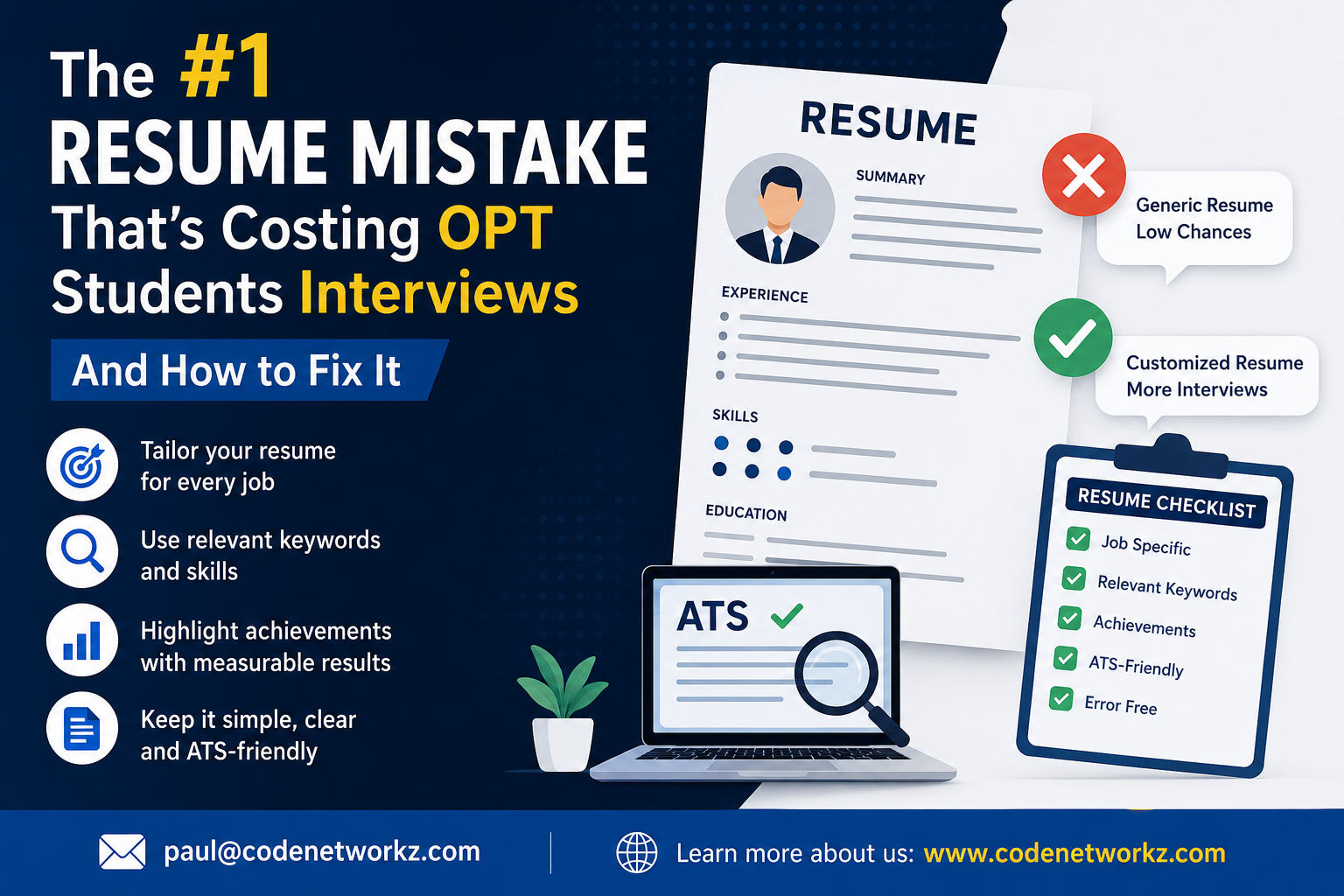
The #1 Resume Mistake That's Costing OPT Students Interviews
The #1 Resume Mistake That's Costing OPT Students Interviews
You've earned your degree. You've completed projects, learned in-demand technologies, and are excited to begin your career in the United States through Optional Practical Training (OPT).
Then reality hits.
You apply for 50 jobs. Nothing.
You apply for 100 jobs. Still nothing.
Soon you've sent out hundreds of applications with little or no response.
If this sounds familiar, you're not alone. Thousands of OPT students face the same challenge every year.
The good news? The problem isn't always your experience or technical skills.
In many cases, it's your resume.
A poorly written or generic resume can prevent even highly qualified candidates from getting interviews. Before a recruiter sees your application, your resume often has to pass an Applicant Tracking System (ATS). If it doesn't match what employers are looking for, it may never reach a human reviewer.
Let's look at the biggest mistake that keeps OPT students from getting interviews—and how you can avoid it.
The Biggest Resume Mistake: Using the Same Resume for Every Job
One of the most common mistakes OPT students make is creating a single resume and using it for every application.
It may seem efficient, but it's one of the fastest ways to reduce your chances of getting interviews.
Every employer has different expectations. Even similar job titles require different skills, tools, and technologies.
For example:
- A Java Developer role may emphasize Spring Boot, REST APIs, and Microservices.
- A Full Stack Developer position may require React, Node.js, and MongoDB.
- A Data Analyst role may focus on SQL, Power BI, Python, and Excel.
Submitting the same resume to all these roles means you're missing important keywords that recruiters and ATS software are searching for.
Why ATS Matters
Most companies use Applicant Tracking Systems (ATS) to screen resumes before a recruiter reviews them.
The ATS scans your resume for:
- Skills
- Technologies
- Job titles
- Certifications
- Keywords from the job description
- Relevant work experience
If your resume doesn't contain enough matching information, it may be filtered out automatically.
That means even a qualified candidate can be rejected simply because the resume isn't optimized.
Customize Every Resume
Instead of sending one generic resume everywhere, tailor it for each application.
Read the job description carefully and identify:
- Required technical skills
- Preferred tools
- Programming languages
- Certifications
- Responsibilities
Then update your resume to include those keywords where they accurately reflect your experience naturally.
Spending just 10–15 minutes customizing your resume can significantly improve your interview rate.
Focus on Achievements, Not Responsibilities
Many resumes only describe what the candidate did.
For example:
- Worked on Java development.
- Participated in testing activities.
- Assisted the development team.
These statements don't show your value.
Instead, highlight your impact.
Examples:
- Developed REST APIs using Spring Boot that improved application performance.
- Optimized SQL queries, reducing response time by 35%.
- Automated regression testing, decreasing manual testing effort by 40%.
- Built responsive React dashboards for internal business users.
Whenever possible, include measurable results.
Numbers immediately make your resume more credible.
Projects Are Valuable Experience
Many OPT students worry because they don't have years of professional experience.
Employers understand this.
If you're a recent graduate, your projects demonstrate your practical skills.
Include:
- University projects
- Capstone projects
- Internship work
- Personal applications
- Freelance projects
- Open-source contributions
For each project, mention:
- The problem you solved
- Technologies used
- Your responsibilities
- Results achieved
A strong project section can often make the difference between getting noticed and getting ignored.
Write a Strong Professional Summary
Avoid generic summaries such as:
Looking for an opportunity to grow my career in a challenging organization.
Instead, write something specific.
Example:
Computer Science graduate with hands-on experience in Java, Spring Boot, SQL, AWS, and REST API development through academic and internship projects. Passionate about building scalable applications and seeking Software Engineer opportunities under OPT in the United States.
This tells recruiters exactly who you are and what you bring to the table.
Organize Your Technical Skills
Keep your skills section clean and relevant.
Example:
Programming Languages
- Java
- Python
- JavaScript
Frameworks
- Spring Boot
- React
- Node.js
Databases
- MySQL
- PostgreSQL
- MongoDB
Cloud & DevOps
- AWS
- Docker
- Jenkins
- Git
Only list technologies you can confidently discuss during an interview.
Make Your Resume ATS-Friendly
Simple formatting works best.
Use:
- Standard fonts
- Clear section headings
- Bullet points
- Consistent spacing
- PDF format (unless another format is requested)
Avoid:
- Graphics
- Tables
- Text boxes
- Icons
- Multiple columns
- Fancy templates
ATS software reads simple resumes more accurately.
Common Resume Mistakes to Avoid
Many resumes are rejected because of simple, avoidable errors.
Watch out for:
- Spelling mistakes
- Grammar errors
- Generic summaries
- Irrelevant skills
- Long paragraphs
- Outdated contact information
- Unprofessional email addresses
Always proofread before applying.
Include the Right Resume Sections
A strong OPT resume should include:
- Contact Information
- Professional Summary
- Technical Skills
- Education
- Internship Experience
- Professional Experience (if applicable)
- Academic Projects
- Certifications
- Leadership or Volunteer Experience (optional)
Arrange sections based on what best highlights your strengths.
Don't Forget LinkedIn and GitHub
Recruiters often check online profiles before scheduling interviews.
Keep your LinkedIn profile updated with:
- Professional headline
- Skills
- Certifications
- Internship experience
- Projects
- Professional photo
If you're applying for technical roles, include your GitHub profile.
Employers appreciate candidates who showcase real coding work.
Final Resume Checklist
Before submitting your application, ask yourself:
✔ Is this resume customized for the job?
✔ Does it include relevant keywords?
✔ Are achievements measurable?
✔ Is the formatting ATS-friendly?
✔ Are spelling and grammar correct?
✔ Have I included relevant projects?
✔ Is my LinkedIn profile updated?
✔ Is my GitHub profile active?
If you can answer "yes" to these questions, you're giving yourself a much better chance of getting shortlisted.
Final Thoughts
Your resume is often your first impression—and sometimes your only opportunity to capture a recruiter's attention.
The biggest mistake OPT students make isn't having limited experience. It's sending the same generic resume to every employer.
A well-crafted, targeted resume that highlights your skills, projects, achievements, and relevant keywords can dramatically improve your chances of landing interviews.
Take the extra time to customize each application. It may only take a few additional minutes, but it can make the difference between being overlooked and receiving an interview invitation.
Your career starts with a resume that tells your story clearly, confidently, and professionally.
Need Expert Resume Help?
Whether you're an OPT student, CPT candidate, or recent graduate, a professionally optimized resume can help you stand out in today's competitive job market.
📧 Email: paul@codenetworkz.com
🌐 Website: www.codenetworkz.com
Get expert guidance on ATS-friendly resumes, interview preparation, job search strategies, and career opportunities designed for international students in the USA.