
Stop Applying to 500 Jobs! Why Most CPT Students Never Get a Callback (2026 Guide)
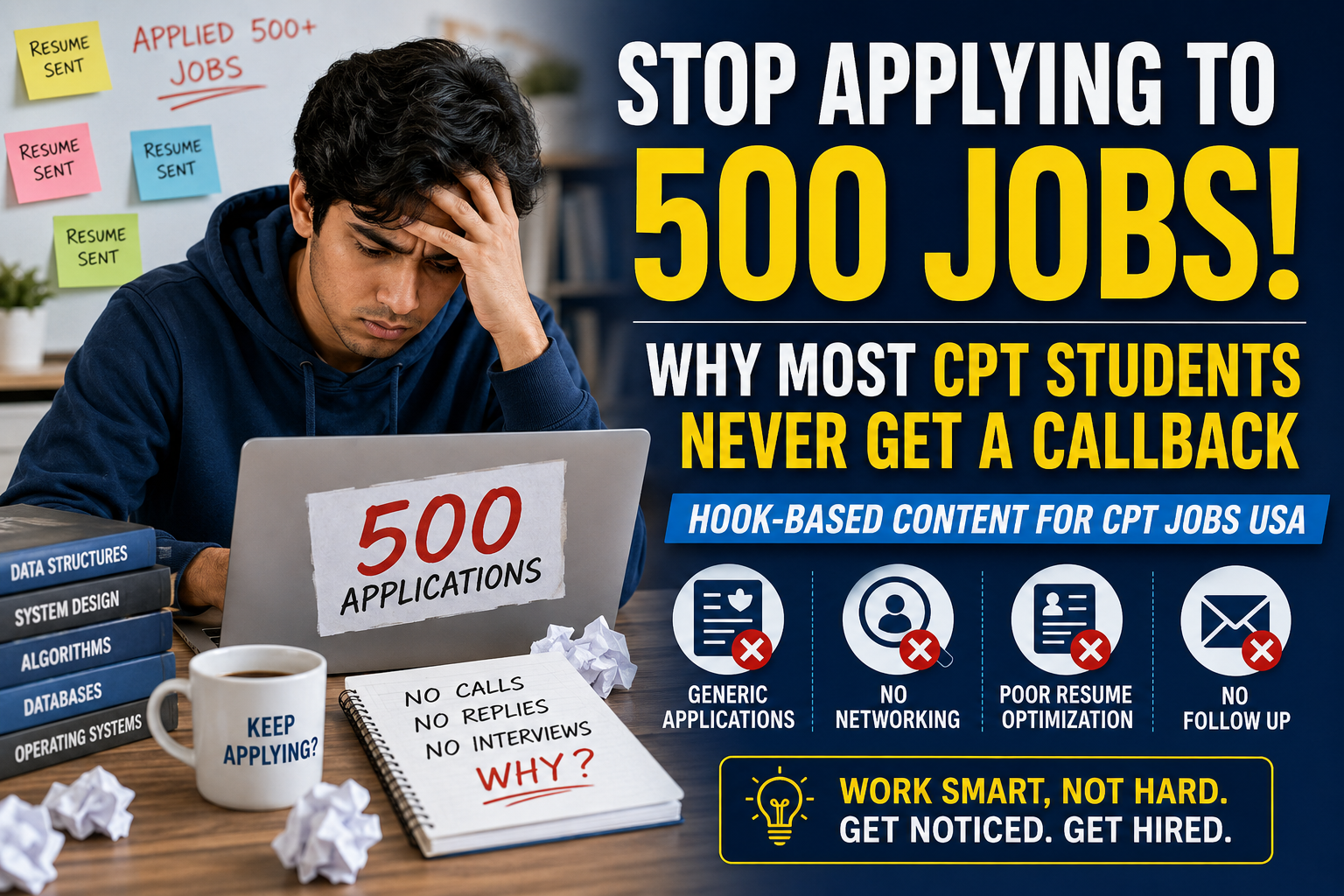
Stop Applying to 500 Jobs! Why Most CPT Students Never Get a Callback (2026 Guide)
Stop Applying to 500 Jobs! Why Most CPT Students Never Get a Callback
If you've applied to hundreds of jobs in the U.S. and your inbox is still empty, you're not alone.
Every semester, thousands of international students on CPT (Curricular Practical Training) submit hundreds of applications hoping for interviews. They spend hours tweaking resumes, refreshing LinkedIn, and applying to every job they can find. Yet, most never receive a callback.
The problem isn't always your skills.
More often, it's your job search strategy.
In 2026, U.S. employers receive hundreds—even thousands—of applications for a single role. Recruiters spend only a few seconds reviewing each resume before deciding whether to move forward.
If you're applying without a targeted approach, you're competing against everyone else using the exact same strategy.
Here's why that doesn't work—and what successful CPT students do differently.
The Biggest Mistake: Applying Everywhere
Many students believe:
"The more jobs I apply for, the better my chances."
Unfortunately, this rarely works.
Imagine sending 500 generic resumes to 500 companies.
Your resume isn't customized.
Your LinkedIn isn't optimized.
You don't know the hiring manager.
You don't meet every requirement.
You never follow up.
From the recruiter's perspective, you're simply another application in a massive pile.
Quantity without quality produces very few interviews.
Why Recruiters Skip Most CPT Applications
Recruiters aren't trying to reject candidates.
They're trying to fill positions quickly.
Most resumes are rejected because they immediately raise questions such as:
- Does this candidate have the required technical skills?
- Can they legally work through CPT?
- Is their resume tailored for this role?
- Do they have relevant projects?
- Have they explained their work authorization clearly?
If those answers aren't obvious within seconds, recruiters move on.
ATS Is Filtering Your Resume First
Before a recruiter even sees your resume, an Applicant Tracking System (ATS) often reviews it.
The ATS checks for:
- Required skills
- Keywords
- Experience
- Certifications
- Job titles
- Education
- Resume formatting
If your resume doesn't match the job description, it may never reach a recruiter.
Many CPT students unknowingly use resumes designed for every job instead of one tailored for each opportunity.
Your Resume Isn't About You
Most resumes focus on responsibilities.
Recruiters care about results.
Instead of writing:
- Worked on Java applications
Write:
- Developed Java microservices that improved API response time by 30%.
Instead of:
- Participated in testing
Write:
- Automated 200+ regression test cases using Selenium and reduced manual testing by 40%.
Numbers create credibility.
Applying Within 24 Hours Matters
Timing can be the difference between getting noticed and getting ignored.
Many recruiters begin reviewing resumes immediately after posting a job.
If you apply several days later, the interview shortlist may already be complete.
Set job alerts for:
- LinkedIn Jobs
- Indeed
- Dice
- Handshake
- Company career pages
Being early gives your application a significant advantage.
Stop Ignoring LinkedIn
Your LinkedIn profile is often reviewed before your resume.
An incomplete profile raises concerns.
A strong LinkedIn profile should include:
- Professional headline
- Technical skills
- Projects
- Certifications
- Portfolio or GitHub
- Internship experience
- Professional photo
- Recommendations whenever possible
Recruiters frequently search LinkedIn before scheduling interviews.
Networking Beats Cold Applications
Many CPT students rely entirely on job portals.
Successful candidates build relationships.
Networking can happen through:
- University alumni
- Professors
- Career fairs
- LinkedIn connections
- Technology meetups
- Hackathons
- Student organizations
One referral often carries more weight than dozens of online applications.
Build Projects That Solve Real Problems
Recruiters want evidence that you can build software—not just complete coursework.
Strong projects include:
- AI applications
- Cloud deployments
- Full-stack web applications
- Data engineering pipelines
- Mobile apps
- Machine learning models
- Cybersecurity tools
Host projects on GitHub.
Deploy them online.
Include links on your resume.
Let employers see your work.
Don't Ignore Soft Skills
Technical knowledge gets attention.
Communication earns offers.
Employers look for candidates who can:
- Explain technical concepts clearly
- Work in teams
- Solve problems
- Adapt quickly
- Communicate professionally
- Collaborate with stakeholders
Practice answering behavioral interview questions alongside coding practice.
CPT Students Need a Clear Work Authorization Statement
Many employers misunderstand CPT.
Instead of leaving recruiters guessing, include a short statement such as:
Authorized to work in the U.S. through Curricular Practical Training (CPT). No immediate visa sponsorship required.
This removes confusion early in the hiring process.
Customize Every Application
A resume for a Data Analyst role should not be identical to one for a Software Engineer role.
Before applying:
- Match keywords from the job description.
- Highlight relevant projects.
- Reorder technical skills.
- Adjust your professional summary.
- Emphasize matching experience.
This takes a little extra time but dramatically improves your chances.
Practice Interviews Before You Get One
Many students prepare only after receiving an interview invitation.
By then, it's often too late.
Practice:
- Coding interviews
- SQL questions
- System design
- Behavioral interviews
- STAR method responses
- Mock interviews with peers
Confidence grows through repetition.
Follow Up Professionally
Most candidates apply once and disappear.
Instead:
- Send a thank-you message after interviews.
- Connect with recruiters on LinkedIn.
- Follow up politely after one week if appropriate.
Professional persistence shows genuine interest without being intrusive.
Focus on High-Demand Skills in 2026
The U.S. technology market continues to value professionals with expertise in:
- Artificial Intelligence (AI)
- Machine Learning
- Cloud Computing (AWS, Azure, GCP)
- Cybersecurity
- Data Engineering
- DevOps
- Python
- Java
- React
- Node.js
- Kubernetes
- Terraform
- Salesforce
- SAP
- Snowflake
Continuous learning makes your profile more competitive.
Create a Weekly Job Search System
Instead of applying randomly, follow a structured routine.
Monday
- Update resume
- Review new job postings
Tuesday
- Submit targeted applications
Wednesday
- Network on LinkedIn
- Reach out to alumni
Thursday
- Practice technical interviews
Friday
- Build portfolio projects
Weekend
- Learn a new technology
- Review interview questions
- Optimize LinkedIn
Consistency beats panic applications.
Quality Always Wins Over Quantity
Here's what two different strategies look like:
Student A
- 500 generic applications
- No networking
- One resume
- No follow-up
Result:
Very few interviews.
Student B
- 40 targeted applications
- Customized resume
- Strong LinkedIn
- Networking
- Referrals
- Portfolio projects
- Follow-ups
Result:
More interview invitations and stronger job opportunities.
The difference isn't luck.
It's strategy.
How CPT Job USA Helps Students
Finding the right internship or CPT opportunity is about more than browsing job boards.
At CPT Job USA, we help international students improve their job search by connecting them with relevant opportunities, offering resume guidance, interview preparation, and practical career resources designed for the U.S. hiring market.
Whether you're looking for your first CPT internship or aiming for a full-time opportunity after graduation, having the right strategy can make all the difference.
Final Thoughts
Applying to 500 jobs isn't a career strategy—it's often a sign that your approach needs refining.
The students who receive callbacks aren't always the smartest or the most experienced. They're the ones who understand how hiring works, tailor each application, build meaningful connections, and present their skills effectively.
Focus on quality instead of quantity. Optimize your resume, strengthen your LinkedIn profile, showcase real projects, and apply with purpose.
One well-targeted application can accomplish what hundreds of generic submissions never will.
Your next opportunity isn't waiting for application number 501. It's waiting for the application that truly stands out.