
OPT Career Guide 2026: Why Your OPT Job Search Isn't Working (And How to Get Hired Faster)
OPT Career Guide 2026: Why Your OPT Job Search Isn't Working (And How to Get Hired Faster)
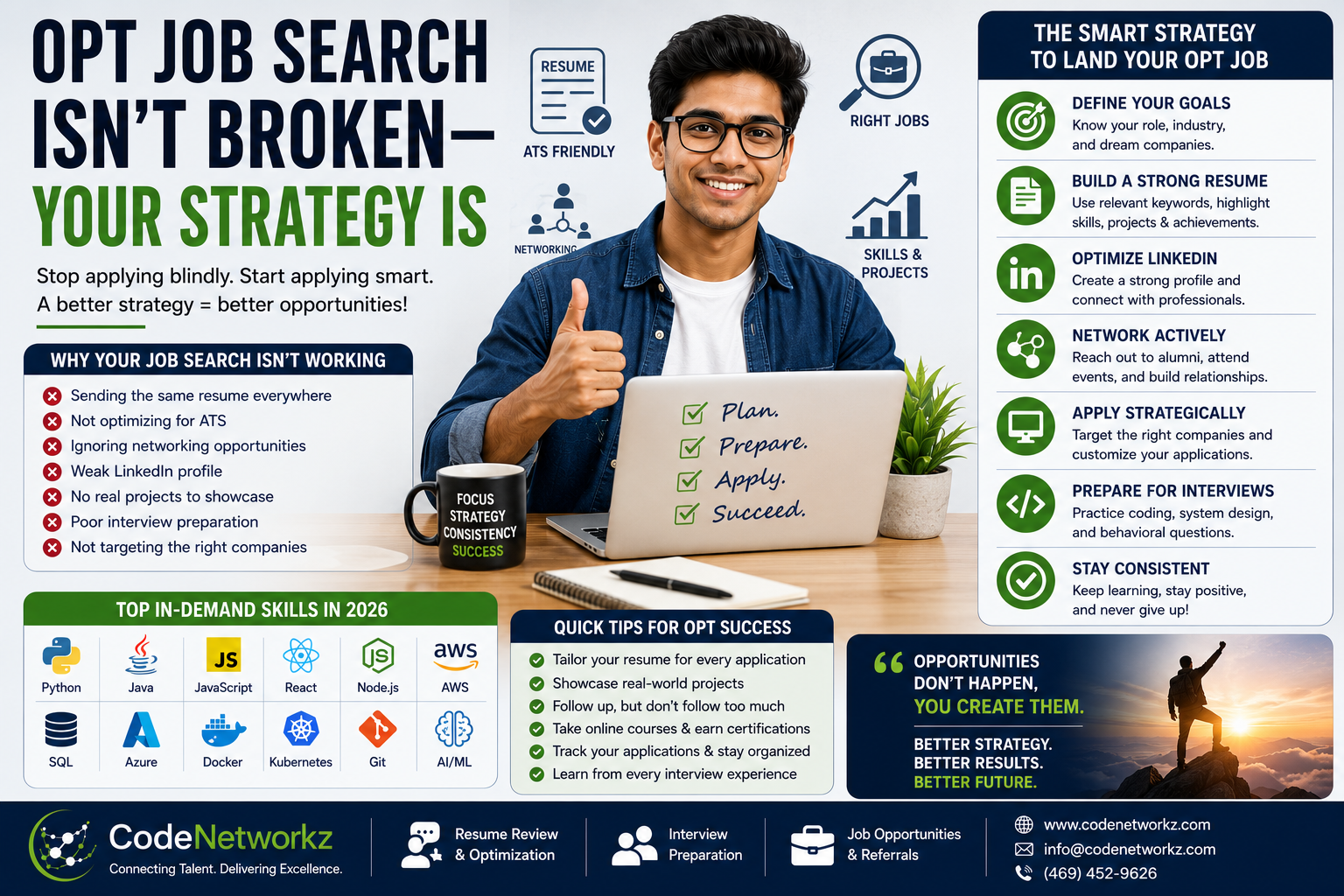
OPT Job Search Isn't Broken—Your Strategy Is
Every year, thousands of international students graduate from U.S. universities with exciting career goals. After years of hard work, earning an Optional Practical Training (OPT) work authorization feels like the perfect opportunity to launch a professional career in the United States. Yet, many graduates quickly become frustrated. They apply to hundreds of jobs, receive very few responses, and begin to question whether the job market is simply too competitive.
The truth is that the OPT job market is active and full of opportunities. Companies across industries continue hiring software developers, cloud engineers, cybersecurity analysts, data scientists, business analysts, SAP consultants, Salesforce developers, and many other technology professionals. The challenge isn't that jobs don't exist—it's that many candidates rely on outdated or ineffective job search strategies.
If you've been sending out applications without receiving interview calls, it may be time to rethink your approach. Success in today's job market depends on strategy, preparation, networking, and presenting yourself effectively.
This guide will help you understand why your current strategy may not be working and what you can do to improve your chances of landing an OPT job in 2026.
Understanding Today's OPT Job Market
The hiring landscape has changed dramatically over the past few years. Employers no longer rely only on job boards to find talent. Instead, they use Applicant Tracking Systems (ATS), recruiter databases, employee referrals, staffing partners, and LinkedIn searches to identify qualified candidates.
At the same time, employers expect candidates to demonstrate more than academic excellence. They want practical skills, project experience, communication abilities, and a willingness to learn.
Understanding how employers hire is the first step toward improving your job search.
Mistake #1: Applying to Every Job You See
One of the most common mistakes is believing that applying to more jobs automatically increases your chances of getting hired.
Imagine submitting 400 applications using the same resume. Most of those applications are unlikely to match the employer's exact requirements, reducing your chances of getting shortlisted.
Instead, focus on quality rather than quantity.
For each application:
- Read the job description carefully.
- Match your skills with the employer's needs.
- Customize your resume.
- Highlight relevant projects and achievements.
A smaller number of targeted applications often produces better results than hundreds of generic submissions.
Mistake #2: Ignoring ATS Optimization
Before your resume reaches a recruiter, it usually passes through an Applicant Tracking System.
ATS software searches for:
- Technical skills
- Keywords
- Job titles
- Certifications
- Experience
- Education
If your resume doesn't contain the right keywords, it may never be reviewed by a recruiter.
Improve your ATS score by:
- Using keywords from the job description.
- Keeping formatting simple.
- Avoiding graphics and tables.
- Creating clear section headings.
- Including measurable accomplishments.
Mistake #3: Depending Only on LinkedIn
LinkedIn is a valuable platform, but it shouldn't be your only job search tool.
Many positions are filled through:
- Employee referrals
- University career centers
- Alumni networks
- IT staffing firms
- Professional associations
- Career fairs
- Company career pages
Expanding your search increases your chances of finding opportunities before they become widely advertised.
Mistake #4: Having an Incomplete LinkedIn Profile
Recruiters frequently search LinkedIn before contacting candidates.
A strong profile should include:
- Professional photo
- Clear headline
- Career summary
- Technical skills
- Certifications
- Portfolio projects
- Internship experience
- GitHub profile
- Recommendations
Treat your LinkedIn profile like an online resume that works for you 24/7.
Mistake #5: Not Building Real Projects
Many graduates list coursework but have little practical experience.
Projects demonstrate your ability to solve real business problems.
Examples include:
- Full-stack web applications
- AI chatbots
- Cloud infrastructure
- Data visualization dashboards
- Mobile applications
- REST APIs
- Machine learning models
Include GitHub links and project descriptions on both your resume and LinkedIn profile.
Mistake #6: Weak Networking
Networking remains one of the most effective ways to find jobs.
Building relationships can lead to:
- Referrals
- Recruiter introductions
- Mentorship
- Industry insights
- Hidden job opportunities
Ways to expand your network:
- Attend career fairs.
- Join technology meetups.
- Connect with alumni.
- Participate in hackathons.
- Join LinkedIn groups.
- Attend professional conferences.
Networking isn't asking strangers for jobs—it's building meaningful professional relationships.
Mistake #7: Neglecting Interview Preparation
Landing an interview is only the beginning.
Technical interviews often include:
- Coding challenges
- SQL problems
- System design questions
- Cloud concepts
- Debugging exercises
Behavioral interviews evaluate:
- Communication
- Teamwork
- Leadership
- Problem-solving
- Adaptability
Practice regularly using platforms like LeetCode, HackerRank, and mock interviews with peers.
Learn Skills That Employers Need
Technology evolves rapidly.
Employers continue hiring professionals with expertise in:
- Python
- Java
- SQL
- JavaScript
- React
- Node.js
- AWS
- Microsoft Azure
- Google Cloud
- Docker
- Kubernetes
- Terraform
- Artificial Intelligence
- Machine Learning
- Cybersecurity
- Data Engineering
- Snowflake
- Power BI
- SAP
- Salesforce
Continuous learning keeps your profile competitive.
Build a Personal Brand
Recruiters often search online before scheduling interviews.
Strengthen your professional brand by:
- Publishing technical articles
- Sharing LinkedIn posts
- Contributing to GitHub
- Creating project demonstrations
- Participating in open-source projects
A visible online presence increases recruiter confidence.
Keep Your Resume Updated
Your resume should evolve with your skills.
Include:
- Recent projects
- Certifications
- Technical achievements
- Quantifiable results
- Leadership experience
Review and update your resume every few months.
Create a Weekly Job Search Plan
Consistency matters more than intensity.
A productive weekly schedule might include:
Monday
- Research companies
- Update resume
Tuesday
- Submit customized applications
Wednesday
- Connect with recruiters
- Network on LinkedIn
Thursday
- Practice coding interviews
Friday
- Build portfolio projects
Weekend
- Learn new technologies
- Earn certifications
- Review interview questions
A structured routine helps you stay focused and motivated.
Common OPT Job Search Mistakes
Avoid these mistakes:
- Sending the same resume to every employer
- Applying without reading job descriptions
- Ignoring ATS optimization
- Weak LinkedIn profile
- No portfolio projects
- Lack of networking
- Poor interview preparation
- Giving up after rejection
Every application is an opportunity to improve your strategy.
Why IT Staffing Can Help
Many employers partner with IT staffing firms to fill positions quickly.
Benefits include:
- Access to exclusive job openings
- Resume guidance
- Interview coaching
- Faster hiring processes
- Contract and permanent opportunities
- Career advice
Working with experienced recruiters can expand your career opportunities.
How CodeNetworkz Supports OPT Candidates
At CodeNetworkz, we help international students and early-career professionals connect with employers across software development, cloud computing, cybersecurity, ERP, AI, data analytics, and enterprise technology.
Our recruitment specialists assist candidates with resume optimization, interview preparation, and access to contract, contract-to-hire, internship, and permanent opportunities. Whether you're beginning your OPT journey or looking for your next career move, we help you present your skills with confidence and connect you with employers seeking top technology talent.
Final Thoughts
Finding an OPT job isn't about luck—it's about having the right strategy. The job market is competitive, but employers continue hiring talented professionals who demonstrate the skills, experience, and mindset needed to succeed.
Rather than sending hundreds of identical applications, focus on creating a targeted job search plan. Optimize your resume for ATS, build meaningful projects, strengthen your LinkedIn profile, expand your professional network, and prepare thoroughly for interviews.
Remember, your OPT period is a valuable opportunity to gain U.S. work experience and build the foundation for a successful career. With consistency, preparation, and a smarter approach, you can turn missed opportunities into interview invitations—and interview invitations into job offers.
The job search isn't broken. With the right strategy, your next opportunity could be closer than you think.