
Contract vs contract to hire vs permanent staffing
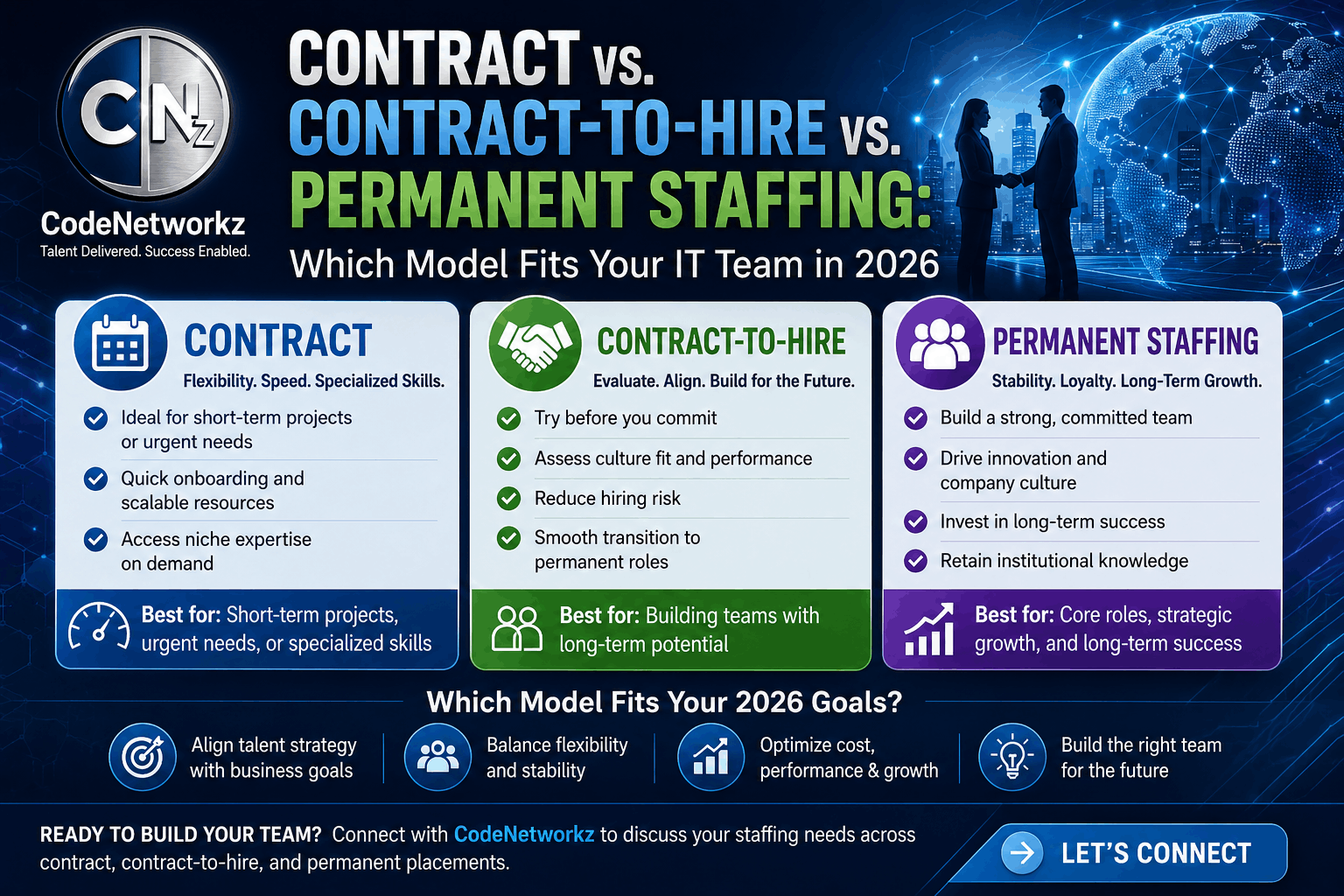
Contract vs contract to hire vs permanent staffing
Why Your Staffing Model Matters More Than Ever
Enterprises are under constant pressure to move fast on technology projects while keeping headcount costs predictable. The staffing model you choose — contract, contract-to-hire, or permanent — directly affects how quickly you can staff a project, how much flexibility you retain, and how much risk you carry if a hire doesn't work out.
In 2026, with AI, cloud migration, and ERP modernization projects competing for the same limited pool of specialized talent, choosing the wrong model can mean losing a candidate to a competitor or overpaying for a role that only needed short-term coverage.
Contract Staffing: Speed and Flexibility
Contract staffing is built for defined-scope work: a six-month cloud migration, a compliance audit, or a temporary surge in application development capacity. You get access to specialized skills without long-term payroll commitments, benefits overhead, or severance risk.
The trade-off is continuity. Contractors are often engaged across multiple clients, so knowledge transfer and documentation become critical if the relationship doesn't convert into something longer-term.
Contract-to-Hire: Try Before You Commit
Contract-to-hire lets you evaluate a candidate's technical skills and team fit over a defined trial period — typically three to six months — before extending a permanent offer. This model is especially valuable for hard-to-reverse hires like senior data scientists, ERP architects, or CRM leads.
It reduces mis-hire risk substantially, since both the employer and the candidate get a real working relationship to assess before either side commits long-term.
Permanent Staffing: Built for Long-Term Ownership
Permanent hires make sense for roles central to your core product, architecture, or strategy — the people you need building institutional knowledge over years, not months. Permanent staffing typically costs more upfront in recruiting fees but avoids the recurring cost and ramp-up time of repeated contractor turnover.
It's the right model when a role requires deep, ongoing ownership of systems, stakeholder relationships, or long-range technical roadmaps.
How to Decide: A Simple Framework
Ask three questions: How long will this need exist? How reversible does this hiring decision need to be? And how much ramp-up time can the business absorb if the hire doesn't work out? Short-term, well-defined needs point to contract. Uncertain fit with long-term potential points to contract-to-hire. Strategic, enduring roles point to permanent.
CodeNetworkz works with enterprises across healthcare, financial services, retail, and technology to structure the right mix of contract, contract-to-hire, and permanent talent. So you're never overpaying for flexibility you don't need or underinvesting in roles that matter long-term.
Ready to build your team? Connect with CodeNetworkz to discuss your staffing needs across contract, contract-to-hire, and permanent placements.